
|
|
#11
 05-17-2006, 01:18 PM
|
|||
|
|||
 Re: Is some of this stuff really art?
[ QUOTE ]
It sounds like someone trying to find meaning in something essesntially meaningless, because they see others doing so and think it sophisticated to appreciate it. Again I will say though, that if Pollock had the artistic skill to paint an extremely good impressionist or landscape painting, then I would be willing to give a little more credibility to his art form, though not much. But as I said, I suspect that he didn't possess that skill, and that neither do so many other abstract artists in whatever media they practice in. [/ QUOTE ] Well I'm not trying to pretend to be sophisticated or grasping at straws, I really do believe what I posted. My opinion is biased though because I have studied art for a long time and went to art school. Many abstract painters are talented artists who created beautiful realistic pictures before they started painting abstractly. Pollock started out as a surrealist and I believe there is evidence of talent in some of his early works. Here's some examples. Male-Female, 1942 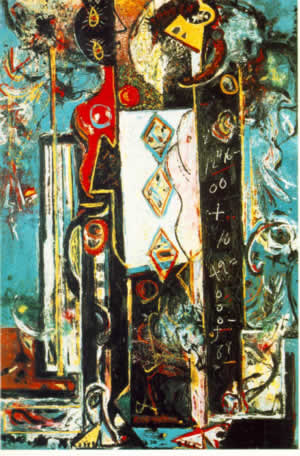 Moby Dick, 1943 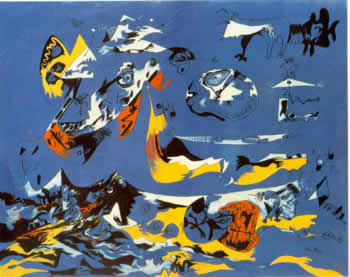 The Key, 1946 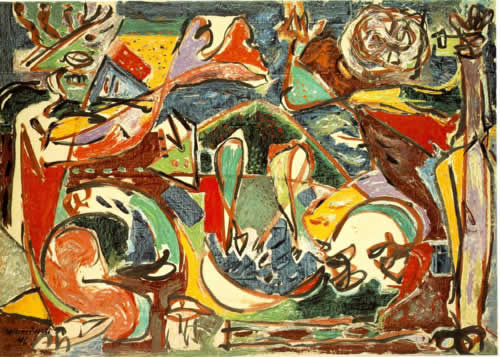

|
|
#12
05-17-2006, 02:42 PM
|
|||
|
|||
|
Re: Is some of this stuff really art?
That's all in the same ballpark. The question is to me, did he or did he not, have the talent to paint excellent paintings in other genres? If he couldn't paint a 1800s american school landscape, or an impressionist painting, then he and others like him, would seem to merely be mediocre artists who paint gobbeldy-gook and claim it to be a brave new art form.
|
|
#13
05-17-2006, 11:29 PM
|
|||
|
|||
|
Re: Is some of this stuff really art?
Here is some of the earliest Jackson Pollock stuff I could find on the internet. The first two are from sketchbooks that may have been drawn while Pollock was in a psychiatric hospital. I see your point BluffThis. Not exactly brilliant stuff here, but interesting to see what he was doing at a young age. I believe I read that both his brothers were artists.
“The first two sketchbooks date from about 1937-1939 and show Pollock experimenting with ways to convey physical tension and gesture. In the figurative drawings, Pollock evidently followed the methods of his teacher and mentor, Thomas Hart Benton -- copying Old Master paintings from art books in pencil and ink. Benton encouraged his students, essentially, to diagram the masterpieces in cubic forms. “ Pollock – Early sketchbook, 1937-1939   1934-1935, Going West 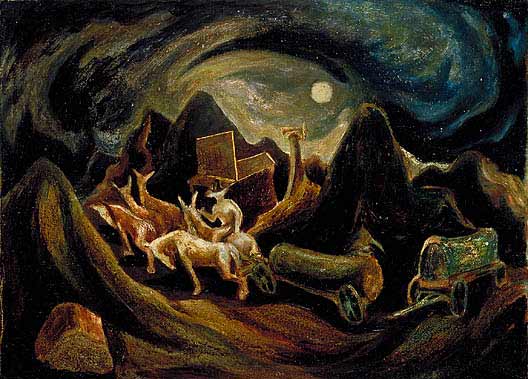
|
|
#14
05-18-2006, 12:21 AM
|
|||
|
|||
|
Re: Is some of this stuff really art?
[ QUOTE ]
[ QUOTE ] His paintings do have a wonderful balance of thin strokes, thick strokes, globs, drips, long strokes, energetic strokes, etc.. There is also a thoughtful rhythm in many of the paintings although they appear random. So he wasn't just randomly dripping paint everywhere. [/ QUOTE ] This seems like something an art critic stoned out of his mind would say, and should apply to a lot of 2nd graders' splatter/finger painting as well. It sounds like someone trying to find meaning in something essesntially meaningless, because they see others doing so and think it sophisticated to appreciate it. [/ QUOTE ] Look.... I know that this is a thread about art, and that, for the most part, with art there are no right or wrong answers, but what you have just said is incorrect. To compare Pollock's paintings to the finger paintings of a second grader is beyond ridiculous. You would be hard pressed to find a second grader who can reproduce numerous paintings that exhibit fractal geometry, and whose paintings increase in fractal dimension as time goes on and as that second grader grows as an artist.
|
 |
|
|


 Linear Mode

