
|
|
#1
 03-07-2007, 09:43 AM
|
|||
|
|||
 Killing off the little guy (this time it\'s internet radio)
[ QUOTE ]
On March 1, 2007 the US Copyright Office stunned the Internet radio industry by releasing a ruling on performance royalty fees that are based exclusively on the number of people tuned into an Internet radio station, rather than on a portion of the station’s revenue. They discarded all evidence presented by webcasters about the potentially crippling effect on the industry of such a rate structure, and rubber-stamped the rates requested by the RIAA (Recording Industry Association of America). Under this royalty structure, an Internet radio station with an average listenership of 1000 people would owe $134,000 in royalties during 2007 - plus $98,000 in back payments for 2006. In 2008 they would owe $171,000, and $220,000 in 2009. There is no way for a station with 1000 listeners to make that kind of money. That’s over $11 per listener per month in 2007. No Internet radio station currently operating comes even close to that kind of income. Also keep in mind that 1000 listeners is not a large number. Popular stations like Radio Paradise, SOMA, Digitally Imported, radioio, etc have many times that many listeners. In other words, if they are allowed to stand these rates are a death sentence for independent Internet radio stations. The only stations that would survive would be those who can afford to operate at that kind of loss, such as AOL (who would owe over $20,000,000 in 2006, far in excess of their income from radio). http://www.saveourinternetradio.com/about/ [/ QUOTE ] This is how it works: The state is the final arbiter in any dispute within it's territory. Including disputes that include themselves as a party. This power reaps great benefits, because you can sell this power and grant special priviliges or enact laws that benefit a certain party over another party. And those who stand to benefit from this are willing to pay large amounts of money to get it. A few examples of this: * 'Anti-trust' laws - the tobacco industry. The state helps a few large firms establish a cartel who now control something in the order of 97% of the market (lecture on the protectionist origins of anti-trust laws) * Minimum wage laws - unions bribe for minimum wage laws, killing off competition of cheap labor * Milk cartel - you cannot produce and sell milk under state regulated prices * Sugar - 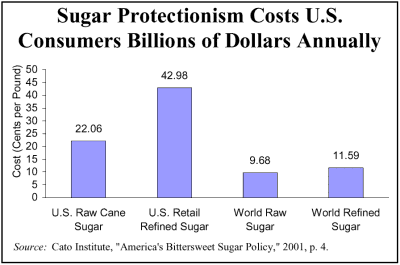 * And now: radio. The big businesses of pre-internet face a new kind of competition. They bribe the state for laws that make the new kind of competition worse off than themselves. It's important to note that the consumer always loses. Whenever a section of the market is socialized, their choices go down, the prices go up, the quality goes down, the state grows in size, taxes go up; and they're a step further in the abyss of non-thinking because the fact that it's now a state controlled sector means that they have to believe in the virtue of it (as happened to education, healthcare, road-building, and so on). This kind of mechanism is also called mercantalism, corporatism or state capitalism. The market anarchist views the core of the problem with the territorial monopolist. Because without the existence of the monopolist, businesses can only compete in the market and not through bribes and preferential treatment. Only through a (violent) monopolist can such costs ultimately be forked back over to the citizen. 
|
|
|


 Threaded Mode